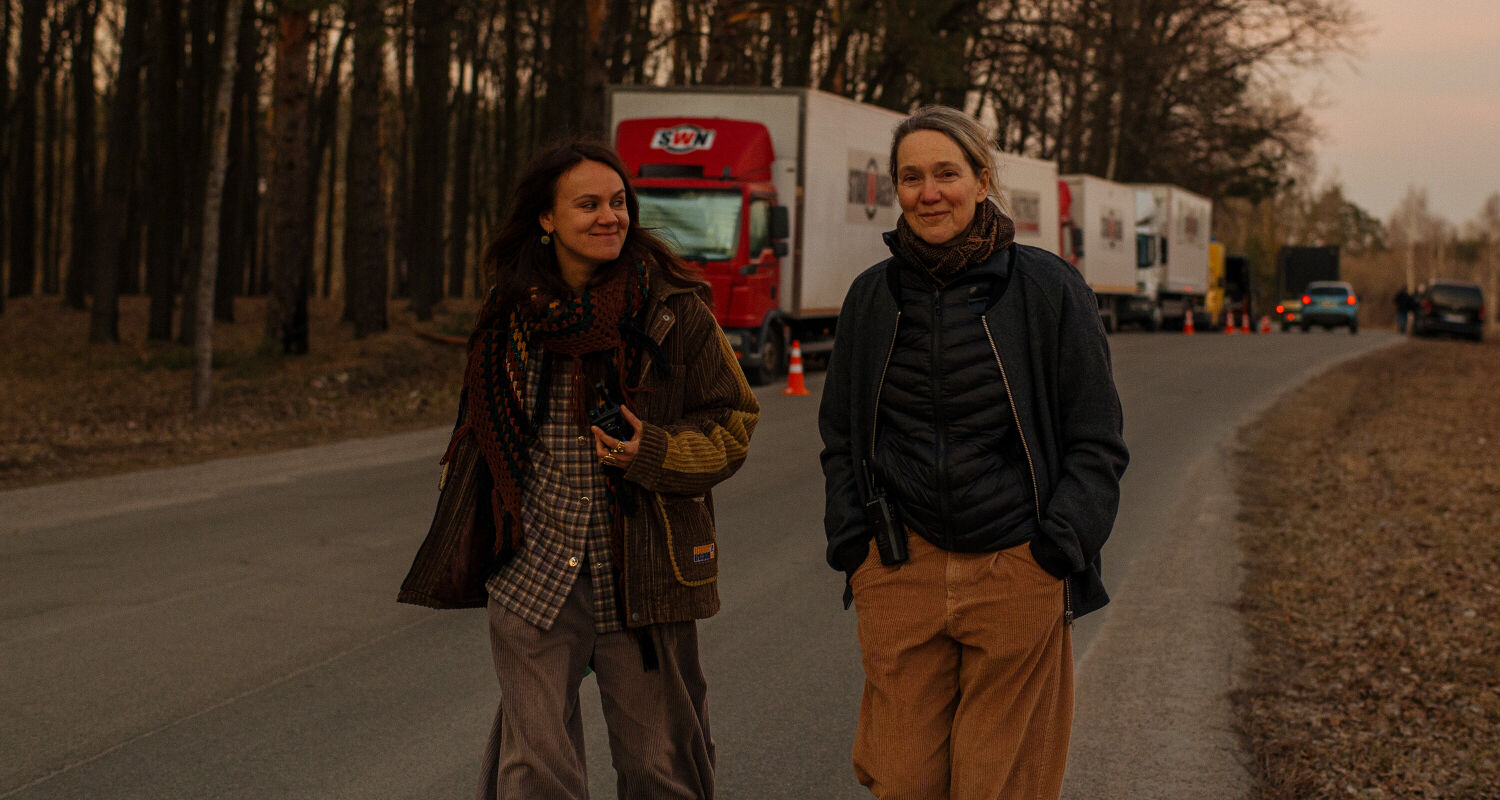
“Our film creates a space for questions that have no simple answers” – filmmakers Isabelle Stever and Anna Melikova discuss I Rarely Wake Up Dreaming
• EACD
• Programming
Since Russia’s full-scale invasion in 2022, we have seen a series of powerful films from Ukraine which have explored the devastating impact of war on Ukrainian society. The German-Ukrainian drama I Rarely Wake Up Dreaming, which premiered at Lorcano Film Festival earlier this year, offers a particularly distinctive perspective. The story follows young queer couple Olya and Oleh, whose love is put to the test when one partner’s gender transition collides with the war. As militarisation narrows and challenges the boundaries of masculinity and femininity, the couple struggle to preserve their bond and sense of self.
Ahead of European Arthouse Cinema Day, CICAE spoke to director Isabelle Stever and screenwriter Anna Melikova, who previously worked together on Grand Jeté (2022) and are collaborating again for this project. They discussed the film’s real-life origins, their search for authenticity, and the story’s topical significance.
Inspired by real events
Anna Melikova: The story of this film is largely based on the real experiences of my queer friends. I actually wanted to write about them in a screenplay before the full-scale invasion started, focusing on their private story and how gender transition influences relationships. Then the full-scale invasion began and my focus shifted from a private, individual story to a political, historical, and collective story. When I started to write I already knew that I would combine these two very big topics: gender transition and war. But it was reality which put these two topics together.
To be more precise, it was Isabelle, who inspired me to start to write. During the first few months of the war, it seemed to me that, that there was nothing else outside of the war I wanted to focus on. And then Isabelle told me, that I have to think how I could turn my anger or my despair into something constructive. Writing could also help me not to feel so helpless in the face of a cruel reality. First I thought: No, I can’t do it, because I will end up exploiting the war. But Isabelle told me that I have to work out how to talk about the war in a way that is not exploitative.
Personal freedom collides with collective survival
Isabelle Stever: We didn’t want to exploit the war or our characters in order to achieve certain emotions in our audience. Therefore we do not show the violence of war explicitly in the film. Instead, we tried to show how the war alters relationship and invades everyday life. For example, there is a side story about a teenage girl who might have experienced violence – we see bruises on her body, but it is very important that we do not know for sure what exactly happened to her. We hear in the news about the massacres in Bucha and about the rapes. We assume that Olya who comes from Donbas, probably experienced or witnessed violence by the occupiers in her teenage years. With this in mind, we project that the bruises on the body of the teenage girl are a result of violence inflicted upon her. But, because we don’t know it for sure, we don’t pity the character, but instead we reflect on the impact this situation has on our thoughts and emotions.
Real dialogue and experiences
Anna Melikova: For the script, I used some real dialogue taken from the real people upon whom the characters are based. With their permission, I recorded our conversations and their conversations between each other, and integrated some of this into the script.
Isabelle Stever: And for the film the main actors added their own language and personalities to the situations and dialogues. For instance, Markus Bright, who plays Oleh, is a founder of an NGO for autistic people, or people on the autistic spectrum, and he's a trans-activist. Tania Myronyshena, who plays Olya, is a journalist for the Kyiv Independent [a Ukrainian online newspaper].
We provided them with a detailed synopsis of the film and asked them, if they would like to be part of the project and play the roles of Olya and Oleh. During rehearsals in Kyiv, we worked with improvisations developing the protagonists’ backstory and by the time we started filming, Tania and Markus were familiar with Olya and Oleh. They shared memories of events, that we don’t see in the film, but which are nonetheless reflected in the characters of both protagonists. During the filming process, they would be given the scenes in English the evening before the respective filming day and they would translate them into Ukrainian, with dialogue and action still subject to modification. This allowed them to connect to the scenes in their own way and at the same time respond to each other in the moment.
Our role as filmmakers was to listen and to create a space where the perspectives and experiences of the cast and crew could shape the film and make the consequences of the full-scale invasion for the lives of its characters tangible.
It’s not only about Ukraine, but also the danger we feel everywhere
Isabelle Stever: We have accompanied the film to countries worldwide. Often Ukrainians have approached us after the screenings and told us that film reminded them of how it felt when the full-scale invasion started. People from other countries have shared with us that they were able to relate not only to the suffering and power of Ukrainian LGBTQ+ individuals, but also to the suffering and power of Ukrainian society.
Anna Melikova: I would like to add, that I Rarely Wake Up Dreaming is not only about Russia’s full-scale invasion of Ukraine. The thread of war is everywhere, none of us can feel safe anymore. I think that our film asks questions which different people from many different countries are asking themselves right now.
I Rarely Wake Up Dreaming will screen at venues internationally as part of European Arthouse Cinema Day on 22 November 2026.
17.11.2026
Rachel Pronger
Rachel Pronger is a writer, curator and editor based in Berlin. She began her career working for festivals and cinemas across the UK, including Tyneside Cinema, Edinburgh International Film Festival and Alchemy Film & Arts. She has served as a programme advisor for Sheffield DocFest, BFI London Film Festival, Alchemy Film & Arts and Aesthetica Short Film Festival. Her writing on film and visual art has been published by outlets including Sight and Sound, Documentary Magazine, The Guardian, MUBI Notebook, Art Monthly and BBC Culture, and she is the co-editor of online journal Cinema of Commoning. Rachel is also the co-founder of Invisible Women, an archive activist feminist film collective which champions historic work by women and marginalised gender filmmakers through curation, events and editorial. more from the author